




My friend is having her thyroid removed today. After numerous biopsies with inconclusive results, her doctor thought it best to remove the gland. It’ll be biopsied to see if she has thyroid cancer, the 5th most common cancer in women. No one wants to have cancer, but this is one of the better ones to have: The 5-year survival rate is about 97 percent.
It seems as though every woman I talk to either has a thyroid problem or knows someone who does. My mom’s thyroid, for instance, was underactive. All that meant to me was that there was a medical reason for her weight problem. I never really understood what this thing called the thyroid was. With my friend going under the knife, it was time to find out.
Your thyroid gland is located on the front of your neck just above your collar bone. 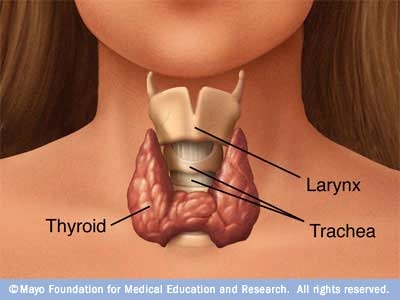 Thanks to the Mayo Clinic for this helpful illustration, but now that Anatomy 101 is done, let’s get to the really important healthful stuff like why your thyroid’s important. For starters, it releases hormones that control things like how fast you burn calories and how fast your heart beats. In other words, it’s critical to your metabolism and therefore your weight. For unknown reasons, sometimes your thyroid starts acting wonky, producing too much hormone (overactive thyroid or hyperthyroidism) or too little (underactive thyroid or hypothyroidism). I have a hard time distinguishing between the two types, so I taught myself this trick: Hypo rhymes with low. If your hormones are low, your body functions will be slow so you won’t be torching many calories. Therefore: Hypo = Low (hormones) = Slow (metabolism) = Hello Weight Watchers! If your thyroid’s in hyper-drive, however, it’s revved like a hyperactive kid and using up all kinds of energy, including the calorie kind. As a result, you have no problem sliding on those skinny jeans. Since our country isn’t in the grips of a supermodel crisis, it should come as no surprise to hear that more of us have clunker thyroids than Porsches (about 5 percent have underactive thyroids or hypothyroidism compared to 1 percent with overactive thyroids or hyperthyroidism).
Thyroid cancer is a slightly different animal. According to the American Cancer Society, more than 44,000 Americans (75 percent of them women) were diagnosed with thyroid cancer in 2010. The disease will claim the lives of close to 1,000 women this year. The number of people diagnosed with thyroid cancer is on the rise, though experts say this may be due to new technology that makes it easier to find small cancers early. As I mentioned, the survival rate is very good, though it certainly helps if you know the symptoms of thyroid cancer which include difficulty swallowing, enlarged lumps in the throat, neck swelling, cough, hoarseness or vocal changes. I have a good feeling that my friend’s results will come back benign or noncancerous. Over the last six months, she’s really struggled with extreme fatigue, weight gain and depression. I hope this is the cure she needs to get her back on a healthy track.